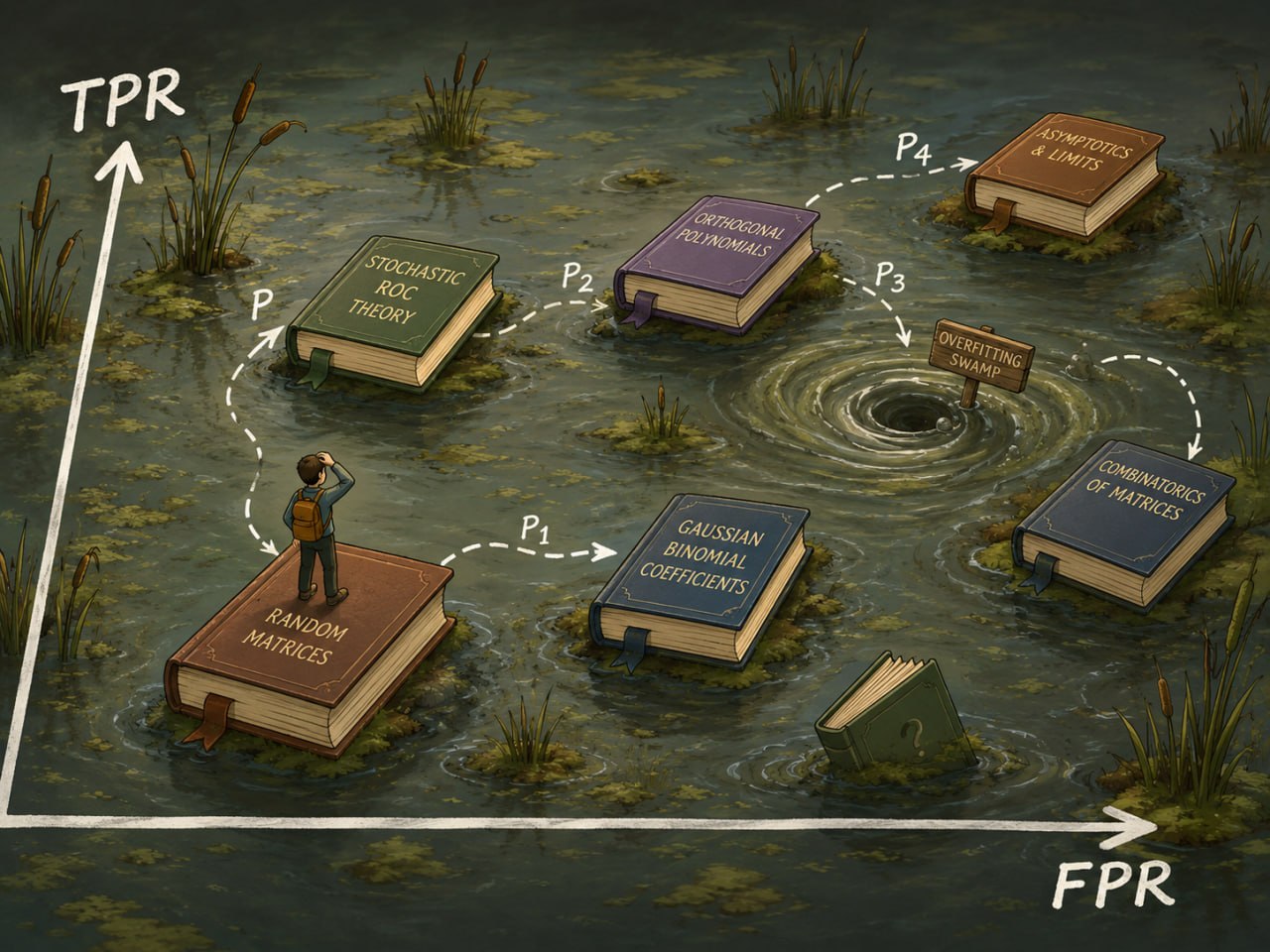
A reading list on Gaussian binomial coefficients, q-binomial coefficients, and their connection to stochastic AUROC
Part 1
Quick orientation / popular sources
👉 Wikipedia — Gaussian binomial coefficient The best first overview.
👉 MathWorld — q-Binomial Coefficient. A compact formula reference.
👉 NIST DLMF, Chapter 17 — q-Hypergeometric and Related Functions; q-Pochhammer symbols, q-binomial coefficients, and the q-binomial theorem. Not the friendliest introduction, but very reliable for formulas.
👉 An Invitation to Enumeration — q-analogues; One of the clearest online introductions to the topic. This is exactly the language needed for random ROC wandering, where a path is weighted by its area.
Gentle textbook-style entry points
👉 George Andrews, Kimmo Eriksson — Integer Partitions Probably the best textbook-style entry point. It has a chapter on Gaussian polynomials, lattice paths and q-binomial numbers, and the q-binomial theorem. A good source if you want understanding rather than just formulas.
👉 Peter Cameron — Notes on Counting: An Introduction to Enumerative Combinatorics A useful source for q-analogues from the finite-vector-space point of view. It explains why the Gaussian coefficient, when q is a prime power, counts k-dimensional subspaces of an n-dimensional vector space over GF(q). This is not the main route for ROC, but it helps explain why the topic is so large.
👉 Laszlo Babai-style notes — q-combinatorics Short lecture notes.
👉 Herbert Wilf — generatingfunctionology Not specifically about Gaussian binomial coefficients, but extremely useful for learning the general language of generating functions. For our purposes, the key habit is: a discrete distribution can be encoded as the coefficients of a polynomial. That is exactly what happens with the AUROC distribution.
👉 Richard Stanley — Enumerative Combinatorics, Volume 1 The classic serious textbook. Not a light introduction, but an excellent reference if you want to place q-binomial coefficients inside the broader world of inversions, partitions, posets, generating functions, and q-analogues.
Historical sources
👉 H. A. Rothe — Handbuch der reinen Mathematik, 1811 Historically important. The original is not an easy read, but Rothe is often mentioned as one of the early published sources for the q-binomial theorem.
👉 P. A. MacMahon — Combinatory Analysis, 1916 A central source for the combinatorial and generating-function tradition. If your interest is “area under a path,” “inversions,” and “partitions,” MacMahon is closer to our ROC story than the purely analytic q-series tradition.
👉 Leonard Carlitz — A set of polynomials, 1940 Not the easiest entry point, but Carlitz is important in the later q-polynomial and finite-field tradition.
👉 Frank Wilcoxon — Individual Comparisons by Ranking Methods, 1945 This is not about q-binomial coefficients, but it is important for the statistical side of the story. It belongs to the origin of rank-based methods, which are directly connected to AUROC.
👉 Mann, Whitney — On a Test of Whether one of Two Random Variables is Stochastically Larger than the Other, 1947 The key historical source for the Mann–Whitney U statistic. AUROC can be viewed as a normalized Mann–Whitney statistic. In our setting, random tie-breaking inside score blocks gives a finite distribution of a closely related statistic.
Hard but interesting sources
👉 George Andrews — The Theory of Partitions A classic work in partition theory. Useful if you want to understand Gaussian polynomials as generating functions for partitions. Deeper and harder than Andrews–Eriksson.
👉 Gasper, Rahman — Basic Hypergeometric Series also option2 The heavy analytic side of q-series. Not necessary for the ROC project at the beginning, but it is a standard deep reference if you move toward basic hypergeometric series.